Living Inside the Voice
The vocalist, composer and sound artist Franziska Baumann brings her performance to the Mixtur Festival, Barcelona 2025
Concert Review by: Meritxell Tena
Sunday, October 19, 2025, Centre d’Arts Santa Mònica.
The space is large, with high ceilings. For some time now, a sizable audience - mostly young people barely out of their twenties - has filled the chairs arranged around two tables cluttered with electronic devices. Cables snake across the floor. There is no stage, no curtain, and the artist, Franziska Baumann, dressed casually, chats with members of the audience.
Everything we usually associate with the ritual of a concert has been left at the door: we are here for another kind of ceremony. And the best part is that even the protagonist herself - singer, improviser, composer, and pioneer in the fusion of voice and technology - does not know where the journey will take us.
Without further ceremony, she steps into the center, and from that moment on it is impossible to take one’s eyes off her. Gesture plays a decisive role in her creative process, and her magnetism is undeniable.
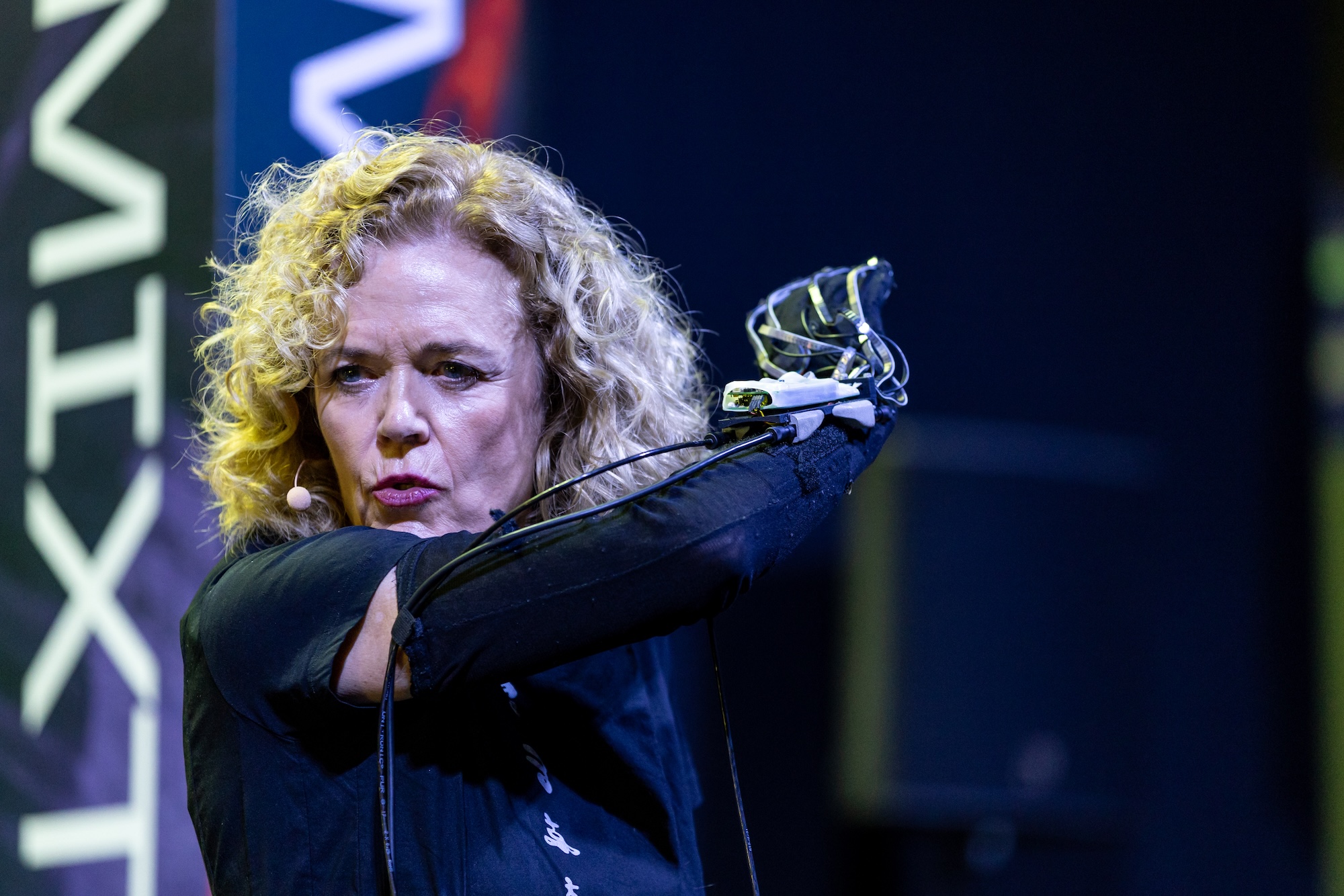
Franziska Baumann with the Sensor Glove at Mixtur Festival 2025
Foto: © Nur Ribas / Mixtur
Baumann is in Barcelona as a guest of Mixtur, a festival devoted to new sound creation. This concept is broad, and the festival’s distinctive trait lies precisely in its embrace of multiple perspectives on contemporary music. The Swiss artist’s work fits within the theme of “The Expanded Voice” - an exploration of the possibilities the human voice can attain when it interacts with technology. All of this unfolds live, with the intention of inhabiting space, sculpting a landscape, and offering us an immersive experience.
The world Baumann creates this morning at Santa Mònica is, curiously, both inclusive and organic. Her voice arises from the depths of humanity, surrounded by sounds that, in the first minutes, resemble birds. The artist maintains full control over the distortions, the volume, and the intensity of what reaches us, thanks to her Sensor Glove, developed by herself - an instrument clearly at her service, not the other way around.
We never lose sight of the fact that there is a person above the machine. The fascination stems above all from witnessing Baumann’s mastery of her voice, her boundless inventiveness, and the courage with which she pushes her instrument to almost inconceivable limits - plosive sounds, guttural tones, percussive noises, whispers, timbral shifts, shrieks - often produced at dizzying speed.
There is technology, yes, but the feeling that slowly unfolds is that of something ancestral, a search for the primordial. Baumann does not seek to erase the human element, but rather to stretch the possibilities of the voice through its integration with electronics - as if she wished to reveal, through technique, what already exists in our nature but remains invisible in the space we inhabit. In her universe - though disruptive - we are invited guests, and the horizon feels infinite.
    There is technology, yes - but the feeling that,
    prevails is that we are dealing with something ancient
    A search for the genuine.
In the second part of the performance, Baumann was joined by Mireia Pellisa on saxophone and Bernat Pont on electronics. The sonic interplay - especially with the saxophonist - was undeniable: Pellisa emitted syncopated sounds that Baumann answered with her voice. The dialogue never exhausted itself; it required us to listen actively and attentively. The path was at times tortuous and seemed to blur in places, yet in the end, we arrived at a serene landscape where the sound invited us to drift into an altered or expanded state of consciousness.
Strangely cradled by Baumann’s ritualized gestures - she herself transformed into her own instrument - we reached the end of a journey that felt somewhat more arid than the first part of the evening, yet remained utterly fascinating and full of surprises. The performer succeeded not merely in producing a series of disjointed sounds but in generating an entirely new world of possibilities - some defined, others only hinted at - and, as creator and deus ex machina of this hybrid woman-machine space, she shaped and animated it before our eyes.
Baumann began by expanding her voice - and ended by expanding our perception.
Translated from Catalan with deepl.com
© 2026 Meritxell Tena